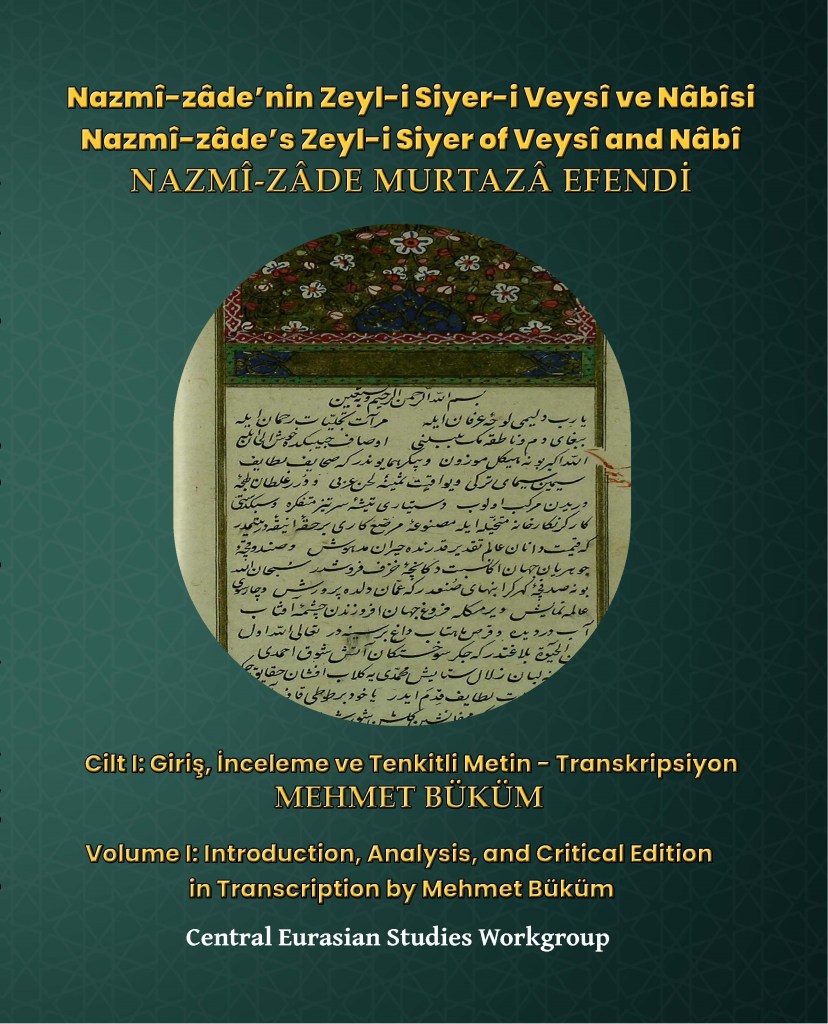
Building upon the earlier efforts of Veysî and Nâbî, the Ottoman Turkish scholar Nazmî-zâde Murtazâ (fl. ca. late-17th, early-18th century AD) wrote his Zeyl-i Siyer, which is an account of the early Islamic community led by the prophet Muhammad. The mid-late Ottoman empire was the leading Muslim power of its time, and Nazmî-zâde’s work lends a window into Ottoman understanding of early Islamic history. The work is written in a high-register Ottoman Turkish prose, and contains verses in Arabic and Persian. The present book is Volume I (Cilt I), in which Dr. Mehmet Büküm provides a meticulous critical edition of the Zeyl-i Siyer (in Latin transcription), together with a host of pertinent scholarly information.
۰۰۰ ۰۰۰ ۰۰۰
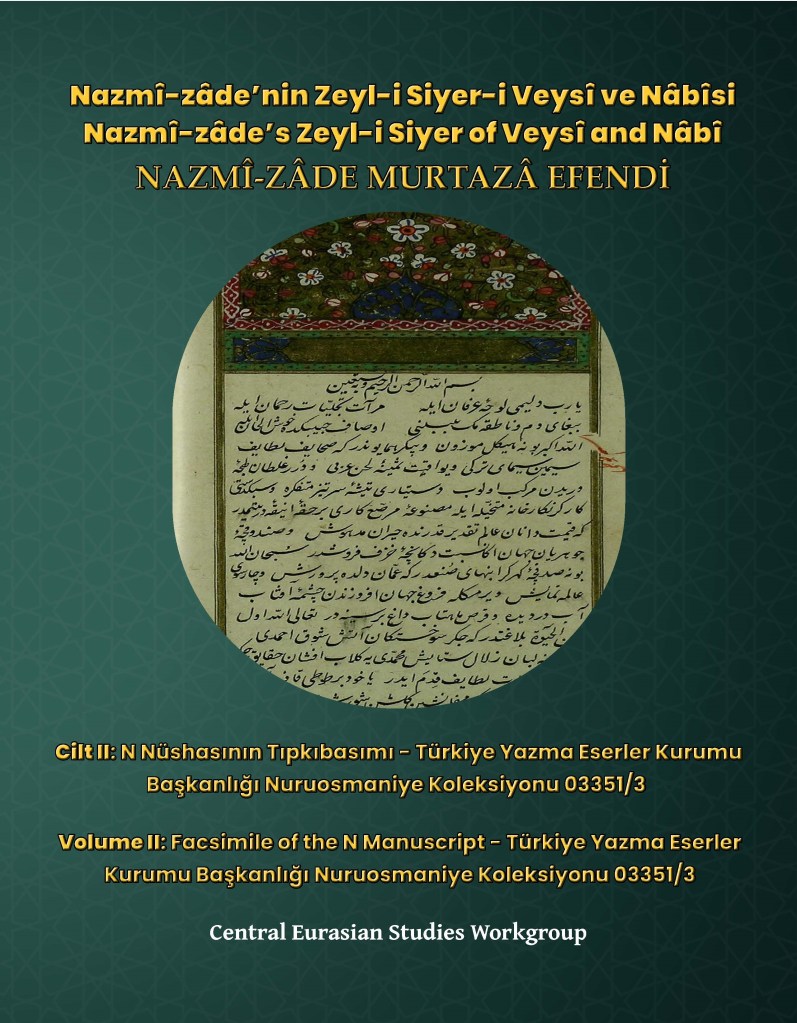
Facsimile of a manuscript of the Zeyl-i Siyer-i Veysî ve Nâbî, by the Ottoman Turkish scholar Nazmî-zâde Murtazâ. This manuscript is held by Türkiye Yazma Eserler Kurumu Başkanlığı, which catalogs it under “Nuruosmaniye Koleksiyonu 03351/3.” The manuscript, which Dr. Mehmet Büküm names “N manuscript” (“N Nüshası”), is one of the three manuscripts that he uses to make his critical edition (tenkitli metin) in Volume I (Cilt I).
۰۰۰ ۰۰۰ ۰۰۰
سوز اوچار یازی قالیر
Words fly, writings stay.
INVITATION TO SEND DRAFTS
Dear Central Eurasian and Middle Eastern studies scholars,
CESWG invites you to send your works, long or short, primary or secondary sources, for potential publication as peer-reviewed books. Whichever stage your brainstorming or draft is at, please contact us as early as possible to plan together: l.javanshir.ceswg@gmail.com
Click HERE to follow us on Facebook
Standard royalty offer: 20% of net revenue from CESWG’s sell of each copy of the work, in exchange for all intellectual property rights in the work. Terms and conditions negotiable and to be stipulated in contract.
In addition to works of original analytical research, language textbooks, and reference materials (e.g., dictionaries), CESWG seeks to publish pre-1900 primary sources in these forms:
(1) edition of original text (especially critical edition), and/or
(2) transcription-transliteration, and/or
(3) English translation (see “Annotated Amplified Translation” and “Basic Translation” in the last two sections of this page). Translation into a language other than English may be considered on a case-by-case basis.
Note 1: Transcription-transliteration and English translation are optional, but preferred.
Note 2: Transcription-transliteration and/or English translation should be accompanied by an edition of the original text based off of manuscript(s). If such manuscript(s) are inaccessible, please contact us for consultation: l.javanshir.ceswg@gmail.com
(4) Facsimile of manuscript is welcome (high-resolution, color preferred), and need not be accompanied by (1), (2), or (3). The contributor must be able to demonstrate ownership of the copyright in the facsimile images or permission to copy the images.
(5) Textbook/reader featuring substantial amount of primary-source texts.
Note: Relevant abstracts, introductions, analytical commentaries, appendices, figures, maps, tables, bibliographies, and glossaries may accompany (1), (2), (3), and/or (4). Indexes are required for long texts, except when (4) is published unaccompanied by (1), (2), or (3).
۰۰۰ ۰۰۰ ۰۰۰
Relatively short works may be published as part of an anthology. Relatively long works would be published as books/volumes.
Policy: Central Eurasian Studies Workgroup (CESWG) will never ask a draft contributor to pay any money or to buy any product or service, as a condition for publishing his/her work or making the said work available for sale.
Courtesy Notice: As a US-based publisher, CESWG is required by US law to withhold 30% of royalty earnings of non-US residents as taxes paid to the US government, unless a royalty earner is eligible for a different taxation rate by law/treaty. See United States Income Tax Treaties.
Disclaimer: CESWG is only bound to the terms and conditions in finalized contracts that it has duly signed, and all such contracts shall be consistent with its Honor Code.
Please follow the Format and Style guidelines below.
Questions, Comments: l.javanshir.ceswg@gmail.com
Format and Style
1. Please send draft as Microsoft Word document
- Paper Size Option 1 (width x height): 6.13″ x 9.25″ (inches) = 15.57 x 23.49 cm
- Paper Size Option 2 (width x height): 8.13″ x 10.25″ (inches) = 20.65 x 26.03 cm
- Note: this paper size is preferred for works with facsimile of manuscript
- Click HERE for HELP
- Top and Bottom Margins: 1″ inch (2.54 cm.)
- Left and Right Margins: 1.1″ inch (2.79 cm.)
- Line Spacing: Single; Before: 0.1 pt, After: 0.1 pt
- Fonts:
– For Latin and Cyrillic scripts, select Georgia, 11 pt for main text, 13 pt for section titles within chapters, and 15 pt for chapter titles.
– For Arabic scripts, select a reader-friendly embedded font (e.g., Simplified Arabic), 16 pt for main text, 18 pt for section titles within chapters, and 20 pt for chapter titles.
– For Chinese script, select KaiTi, 14 pt for main text, 16 pt for section titles within chapters, and 18 pt for chapter titles.
– For all other scripts, please select an embedded font and reasonable font sizes for reader friendliness. Prior consultation with us is recommended.
– For footnotes and endnotes, 10.5 pt for Georgia, and larger for other scripts if needed for readability.
2. Feel free to give either endnotes or footnotes or both, according to what is best for the circumstances of your work.
3. Original text editions, transcription-transliterations, and translations should indicate correspondence with folios in manuscript(s), inserting “[fol. #]” to indicate the start of a folio’s text.
4. Please see our recommendations for transcription-transliteration of Ottoman Turkish and of Chaghatay.
5. For peer-review purposes, please temporarily remove the name(s) of the contributor(s) (translator(s), editor(s), author(s), etc.), acknowledgements and words of appreciation, and anything else that might reasonably reveal the identiti(es) of the contributor(s) or of his or her (their) supporter(s).
6. The Chicago Manual of Style (17th edition) is recommended, but scholars may choose another established scholarly style that best helps present the work. Please clearly indicate in your work the style you use, and adhere to that style accurately and consistently.
7. For works featuring original text edition plus transliteration-transcription and/or English translation, there are the following formatting options:
Option 1:
Place transcription-transliteration and/or translation on the left-hand page, and the corresponding original text edition (or facsimile) on the right-hand page, so that a reader can see both pages at the same time. If transcription-transliteration and/or translation, and both original text edition and facsimile, are all available, make either the original text edition or the facsimile an appendix.
Option 2:
Break down the original text into sentences and/or short passages, with transliteration-transcription below, and/or translation further below. E.g.,
:خواجه ابو المکارم نینک توسطی بیله بو سوزنی اراغه سالدیم کیم
Khwāja Abū’l-Makārimnıñ tawassuṭı bilä bu sözni aragha saldım kim:
With the intercession of Khwāja Abū’l-Makārim, I (i.e., Bābur) put out these words [to be relayed to Shāh Begim and Sulṭān-Maḥmūd Khan]:
“…شیباق خان دیک غنیم پیدا بولوبتور. مونینک ضرری ترککا و مغولغه مساوی دور”
“Shibaq Khan dek ghanīm paydā boluptur. Munıñ żararı Türkkä wa Moghulgha musāwī dur…”
“An enemy like Shibaq Khan (i.e., Muḥammad Shibanī Khan of the Uzbeks) has appeared (has become manifest). The harm of this to Türk and to Moghul is equal…”
—Bābur-nāma, fol. 101b
Note: “(i.e., Bābur)” and “(i.e., Muḥammad Shibanī Khan of the Uzbeks)” are written because the above Bābur-nāma passage was extracted without context. They are not intended to show that every pronoun or name has to be clarified. Rather, such clarification should be given when context is missing or unclear.
Annotated Amplified Translation
Perfectionists-idealists, please follow the following guidelines for producing maximally accurate translations.
“Accurate” means being in accordance with the intent of the original text’s author as can be known through empirical evidence and/or logic. While a text may be open to interpretation due to our insufficient knowledge, only interpretations in accordance with the authorial intent are correct. A translator should note any part of a text that he or she does not (fully) understand and explain why; this would give readers helpful reference(s) for thinking.
Literal translation faithfully conveys original wording, but may not accurately convey meaning. Idiomatic translation accurately conveys meaning, but risks losing original wording as well as adding the translator’s own words that carry meaning(s) unintended by the author. Striking the balance between literal and idiomatic translation has been an age-old challenge. An annotated amplified translation can help towards finding this balance.
It is recommended that words in translation that correspond to words in the original text be put in bold, so that a reader would know that the words not in bold constitute idiomatic translation. See earlier example from Bābur-nāma, fol. 101b.
Do not skip over any word in the original text because it seems to be of minor consequence. Only words that cannot be feasibly translated into correct English would be skipped, and if such words are of consequence to the meaning of the text, explain in annotation.
When a certain English word or passage does not fully capture the meaning of what it attempts to translate, or is ambiguous due to the nature of English, immediately follow the translation with further words or phrases, in parentheses, to maximally capture the meaning.
Put words that are not justified by either literal or idiomatic translation but would help clarify the meaning in brackets ([]).
The Amplified Bible may serve as an effective model for folks unfamiliar with amplified translation:
https://www.biblegateway.com/passage/?search=Genesis+1&version=AMP
Use annotations to further explain what may keep an English reader from fully understanding the meaning of the original text. Also use annotations to explain possible alternative interpretations of words and passages about which the translator is not absolutely certain.
Basic Translation
We understand that annotated amplified translation is a time-consuming endeavor, and we propose it as an ideal, in the pursuit of maximal accuracy. To be pragmatic, basic translations, i.e., smooth-flowing, reader-friendly translations intended to inform readers of the general contents, are also welcome. In fact, to serve the widest readership, the most ideal work would feature the annotated amplified translation in one part, followed by the basic translation (simply having removed the amplifications and relatively technical annotations) in the next part, thereby satisfying the needs of both the exegetist and the skimmer; printing lengthier books as a result would be no big problem for us, and considered very much worthwhile.
Questions, Comments: l.javanshir.ceswg@gmail.com
Click HERE to follow us on Facebook
Disclaimer: CESWG is only obligated to provide good or service pursuant to formal contract to which it is party, and nothing on this page constitutes contract.
Get new content delivered directly to your inbox.
 CENTRAL EURASIAN STUDIES WORKGROUP (CESWG)